
Data Security and Privacy
Protect sensitive data. Stay compliant. Maintain trust
Data Security and Privacy as a Business Requirement
Data and privacy protection is no longer a technical concern limited to IT teams. European organisations must be able to demonstrate that data is governed, used responsibly, and continuously monitored. This requirement is becoming even more difficult to fulfil as Artificial Intelligence (AI) is increasingly intertwined with day-to-day operations. And yet, your cyber resilience and business continuity depend on it.
This page explains what data security and privacy mean in practice, why they matter for European organisations, and how to assess and improve maturity. Click on the sections below to learn more about topics most relevant to your organisation.
Contents
- What are Data Security and Privacy?
- Why Data Security Matters
- What are Common Data Security Challenges?
- How Can Organisations Protect Data While Using AI?
- What are Best Practices in Data Security?
- What is the Data Security Cycle?
- Why Data Privacy Matters
- How can Organisations Assess Privacy Maturity?
- How does Northwave Support Data Security and Privacy?
- Why Choose Northwave for Data Security and Privacy?
- Data Security and Privacy FAQs
“Data is one of your most valuable business assets
and one of the most targeted.”
What are Data Security and Privacy?
Data security is the practice of protecting digital information from unauthorised access, loss, corruption, or misuse. It safeguards how data is accessed and handled across on-premises and cloud environments, AI tools, SaaS applications, employees, and third parties.
Data privacy ensures personal and sensitive data is collected, processed, stored, and shared lawfully, transparently, and for legitimate purposes.
Together, data security and privacy define how well an organisation protects its most critical information. These disciplines build trust, meet regulatory obligations, and ensure business continuity.

Why Data Security Matters
Modern organisations depend on digital data to operate, innovate, and comply with regulation. Moreover, today’s businesses collect and store tremendous amounts of data, making it easy to lose visibility and control over it. Many organisations struggle to answer critical data security questions such as:
- What kind of data are we collecting and storing?
- Where is our sensitive data?
- What is being shared via email or AI tools?
- Do we have insider threats?
Without clear governance and enforceable controls, sensitive information is easily exposed in a data leak or data breach. This can directly translate into financial, legal, and reputational risk.
What's the Difference Between a Data Leak and Breach?
-
A data leak is unintentional exposure of sensitive information, usually due to human error or misconfiguration (e.g., accidentally publishing a file online or putting private data into a public AI tool).
-
A data breach is a deliberate or unauthorised intrusion where an attacker gains access to protected data, often through hacking, malware, or exploiting security weaknesses.
Note that the GDPR does not differentiate between these two situations. Data breach is the term used to describe both unintentional exposure and unauthorised intrusion.

What Are Common Data Security Challenges?
The most common data security challenges today stem from supply chain vulnerabilities, technology complexity, governance gaps, human behaviour, and regulatory pressure. Data is becoming even more difficult to protect as organisations increasingly rely on:
- AI and generative AI tools
- Cloud and SaaS platforms
- Distributed teams and remote access
- Third-party connections and supply chains
Visibility And Governance
Data is distributed across cloud platforms, devices, and third-party tools, making it difficult to maintain visibility and control. In many environments, organisations lack a clear understanding of what data exists, have minimal governance policies and technical enforcement or monitoring.
Human Error And Insider-Related Data Exposure
Accidental data sharing, weak passwords, misconfigurations, and lack of awareness remain leading causes of data breaches. Ungoverned AI tools and large language model (LLM) use intensify this risk.
Regulatory And Compliance Pressure
Requirements such as NIS2, GDPR, DORA and the EU AI Act demand demonstrable data protection and accountability.
Third-Party And Supply-Chain Exposure
Vendors and partners often have privileged access. One weak link can compromise the entire ecosystem.
Legacy Systems And Unpatched Vulnerabilities
Outdated infrastructure and unsupported software continue to create exploitable entry points.
Advanced And Automated Cyber Threats
Attackers increasingly use AI-driven phishing, ransomware-as-a-service, and supply-chain techniques to exploit vulnerabilities at scale.

How Can Organisations Protect Data While Using AI?
- lack of a policy on AI tool usage
- not classifying or protecting sensitive information
- failing to monitor or detect inappropriate AI use
- not providing training to ensure staff understand AI risks
As such, the new challenge for executive leaders is to determine who owns AI governance in the organisation. Then, start taking proactive steps to keep AI tools and Large Language Models (LLMs) from turning into a silent liability.
What are Best Practices in Data Security?
Effective data security relies on strong policies and direction, priorities, and clear governance. These best practices require consistency and maintenance. They’re not one-off projects.
1. Secure Identities
- Apply Conditional Access policies across cloud and on-prem identities
- Enforce MFA (nonSMS), strong authentication, and strict sign-in monitoring
- Monitor and govern Active Directory and all third-party access pathways
2. Harden and Monitor Devices
- Ensure all managed and unmanaged endpoints are secured
- Deploy endpoint protection and EDR (e.g., Defender for Endpoint)
- Maintain continuous device compliance and threat monitoring
- Allow only approved, compliant applications
- Enforce app governance, access restrictions, and continuous monitoring
4. Protect the Data Layer
- After identity, device, and app layers are in place, define clear data handling policies
- Classify and label data before enabling technical controls
- Use technology to enforce policies after defining standards and ownership
Northwave’s Managed Security & Privacy Office (MSPO) helps organisations embed these best practices into daily operations. MSPO provides 24/7 security monitoring, privacy governance, expert guidance, and data-driven insights for continuous improvement. Security controls remain effective, risks stay visible, and compliance obligations are met as the organisation and the threat landscape changes.
What is the Data Security Cycle?
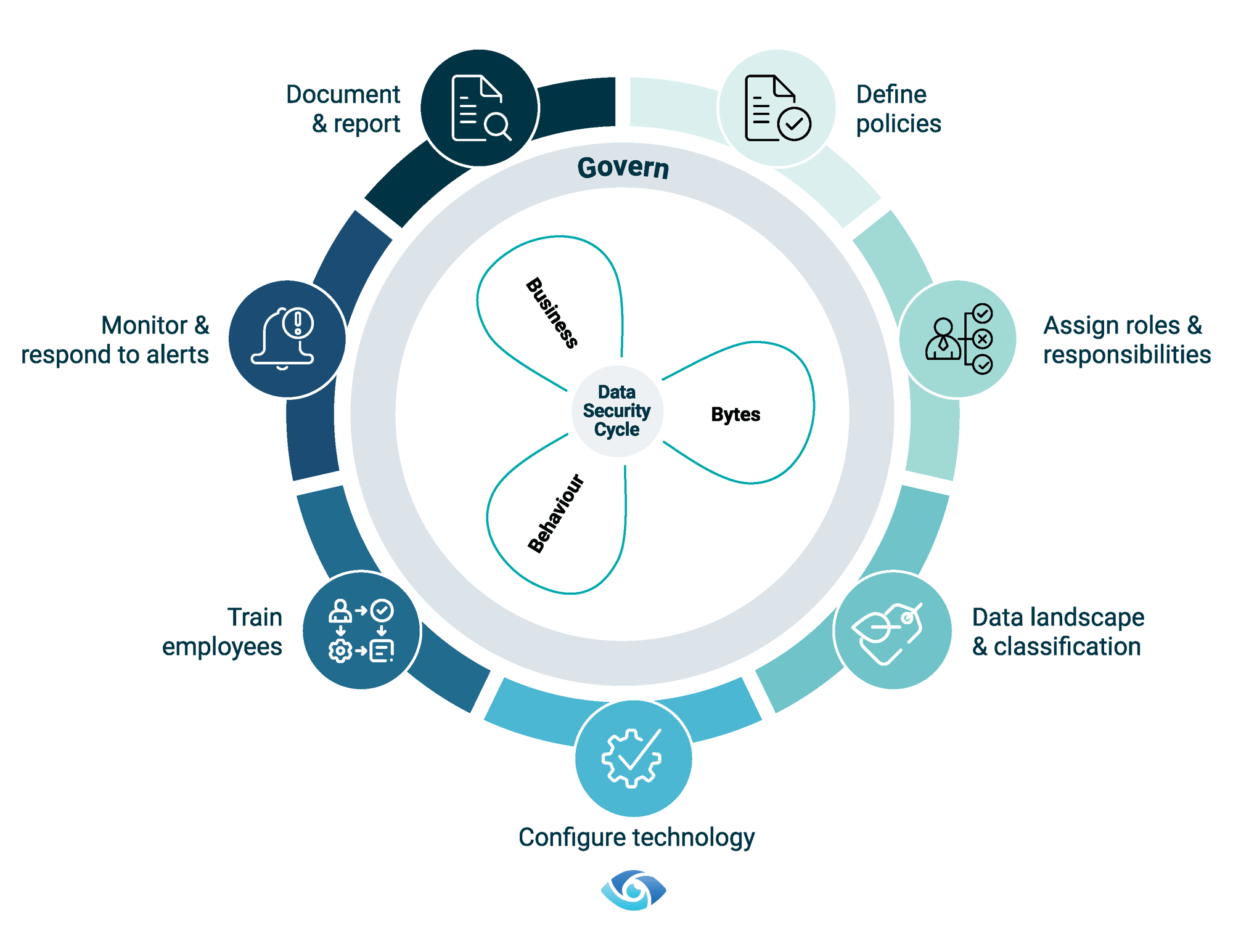
The Data Security Cycle is a practical framework developed by Northwave to guide organisations through each stage of their data protection journey, helping tobuild lasting control and confidence in how sensitive information is managed.
Alongside this framework, Microsoft Purview becomes a powerful tool for easily classifying, labelling, and safeguarding data across the organisation’s digital estate.
Step 1: Define policies
Establish clear, actionable data protection policies aligned with your organisation’s objectives, regulatory obligations, and risk landscape. These policies form the foundation for consistent and compliant data management.
Step 2: Assign roles & responsibilities
Clarify ownership and accountability across departments. Effective data protection depends on every role, from leadership to individual employees, understanding their part in keeping information secure.
Step 3: Data landscape & classification
Gain visibility into where sensitive data resides, how it flows through your organisation, and who has access to it. Classify data according to sensitivity and business value, laying the groundwork for protection, retention, and monitoring measures. This step turns abstract policies into actionable insights and enables effective configuration later in the cycle.
Step 4: Configure technology
Implement and align technical controls with your defined policies. Platforms like Microsoft Purview enable classification, protection, and monitoring of data across the organisation, supporting enforcement of your security standards.
Step 5: Train employees
Raise awareness and build competence. Targeted training and communication help employees recognise sensitive information, follow security policies, and make responsible decisions in their daily work.
Step 6: Monitor & respond
Continuously monitor data activity to detect and respond to risks. Proactive detection, analysis, and response capabilities strengthen resilience and limit potential impact.
Step 7: Document & report
Maintain thorough documentation of your policies, activities, and incidents to demonstrate compliance and enable ongoing improvement. Transparent reporting supports internal governance and external accountability.
Not sure where to begin? Start with visibility.
Northwave’s free Data Security Workshop gives you the insights you need to understand data security, privacy and compliance risks in your organisation. Get a clear view of your 365 data landscape and uncover hidden risks. Then, translate Microsoft Purview capabilities into a clear roadmap for data security improvements.
Why Data Privacy Matters
Data privacy matters to European businesses because it protects people, reduces risk, ensures regulatory compliance, strengthens trust, and provides a competitive advantage in an increasingly digital and regulated market.
Effective data privacy controls helps your organisation maintain:
Business Continuity: By proactively identifying and mitigating privacy risks, you can prevent disruptions caused by data breaches, regulatory fines, or reputational damage.
Digital Trust: Strong privacy practices demonstrate your commitment to protecting personal data and maintaining integrity. This reinforces trust with customers, employees, investors, regulators, and other stakeholders.
Growth and Innovation: A privacy-resilient environment powered by privacy by design creates the confidence and stability needed to pursue innovation and expansion. It enables organisations to explore new technologies, enter new markets, and improve services without being held back by privacy concerns.
Regulatory Compliance: Privacy management provides the structure to meet regulatory requirements like GDPR. By implementing standards such as ISO27701, you are able to clearly demonstrate compliance to auditors and stakeholders.

How Can Organisations Assess Privacy Maturity?
A mature privacy program demonstrates strong governance, proactive risk management, and continuous improvement. Organisations can assess privacy maturity by evaluating how well they manage personal data and comply with regulations. Common methods include:
- Using recognised frameworks like the ISO/IEC 27701 to benchmark current practices.
- Data mapping to understand where personal information resides and how it flows.
- Reviewing policies and governance to ensure roles, responsibilities, and procedures are clearly defined. Risk and compliance audits, including Privacy Impact Assessments (PIAs) and Data Protection Impact Assessments (DPIAs).
- Measuring employee awareness through targeted training programs and integrating privacy principles across the organisation.
Northwave offers several ways to help organisations understand their privacy maturity and check if they need additional governance or dedicated support to be safe and compliant.
Privacy Quick Scan
Short, pragmatic report highlighting potential privacy risks, gaps in processes, and overall awareness levels. Ideal for organisations that need fast, high-level insight into their privacy maturity or have limited existing documentation.
GDPR GAP Assessment
In-depth report that maps compliance gaps and helps determine next improvement steps, such as a DPIA. Designed to for organisations that want to validate whether existing documentation and controls are sufficient.
Data Protection Impact Assessment
Identify privacy risks in processes in scope and mitigate them, while remaining focused on your core business. Gain control of GDPR compliance for projects or changes in your processes. We blend both EU standards, including the ISO/IEC 27701:2025 norm, and industry best practices in our DPIA approach.
Not sure what your next step should be? Book a free consultation with a Northwave Privacy expert.
How Northwave Supports Data Security and Privacy

Technical Security Controls
- Encryption for data at rest and in transit
- Identity and Access Management (IAM)
- Zero Trust architectures
- Endpoint Detection & Response (EDR)
- Network security and segmentation
- Cloud Security Posture Management (CSPM)

Data Security, Privacy and Compliance Services
- Data mapping and classification
- Privacy Quick Scans and GDPR GAP Assessments
- Data Protection Impact Assessments (DPIAs)
- Data retention and minimisation strategies
- Policy development and documentation
- Data Security Workshops
- Secure AI governance frameworks
- Data Security Essential Implementation with Microsoft Purview

Operational and Strategic Services

Why Choose Northwave for Data Security and Privacy?
Hundreds of European organisations rely on Northwave to help them protect sensitive data and navigate complex regulatory requirements. We combine deep technical expertise with governance, compliance, and real-world incident experience. Our proven approach helps organisations shift from fragmented controls to holistic data security and privacy operations.
Organisations choose Northwave because we provide:
- Certified experts with hands-on experience in security, privacy, and incident response
- Proven support across regulated industries and complex environments
- Scalable services that grow with your organisation
- A strong, practical focus on European compliance and accountability
- 20 years of experience as a trusted cyber security partner in Europe
Start getting control over your data security and privacy. Contact Northwave today for a free consultation.
What is the difference between data security and cyber security?
Cyber security focuses on protecting systems, networks, identities, applications, and infrastructure from digital threats. It covers everything from identity protection to endpoints, cloud environments, and monitoring.
Data security is a subset of cyber security that focuses specifically on protecting the data itself, regardless of where it resides. It’s about ensuring making sure data is classified, encrypted, governed, and accessed only by the right people at the right time.
What causes most data breaches?
Human error, phishing, weak credentials, and misconfigured systems are the most common causes.
How can small and medium-sized businesses improve data security?
Clearly establish which data you are going to protect. Identify which data is most critical to your business continuity, determine which labels are associated with that data, and specify the policies and technologies required to safeguard these business assets. Here’s a quick checklist:
- Classify and label data
- Enforce encryption
- Set retention rules
- Prevent data leakage (DLP), especially involving AI tools
- Control how data can be shared or stored
What is Zero Trust?
A security model where no user or device is trusted by default. Every access request is verified.
Why is encryption important?
Encryption ensures that stolen or intercepted data cannot be read without the correct keys.
How does Microsoft Purview help protect data security and privacy?
Microsoft Purview is a unified data governance and compliance solution that enables organisations to discover, classify, and protect sensitive information across on-premises, cloud, and hybrid environments.
We are here for you